
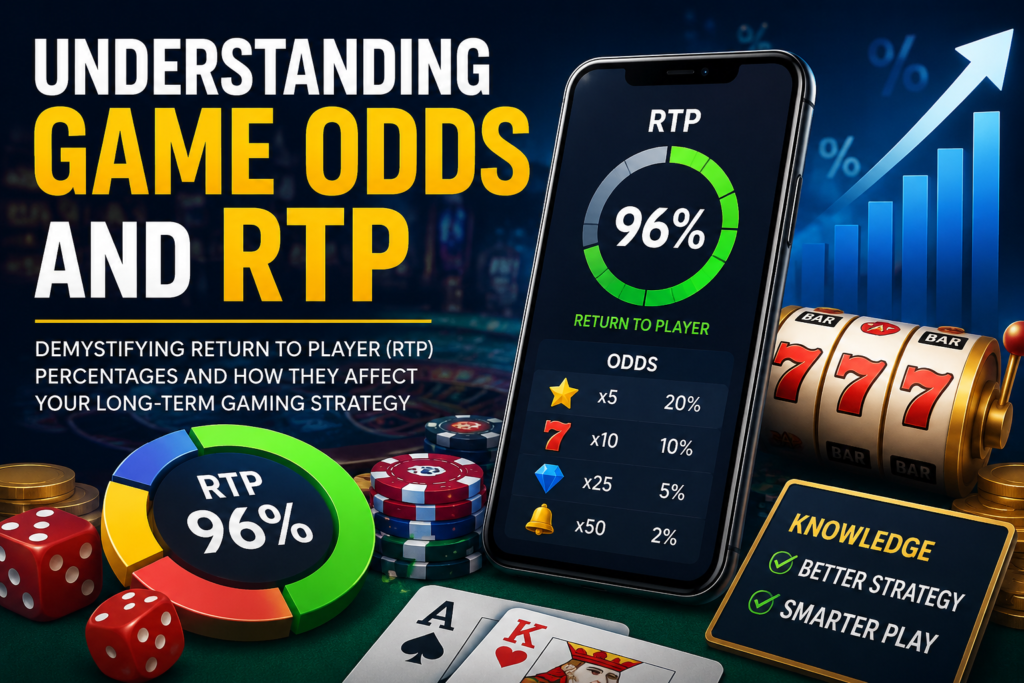
A beginner-friendly guide to Return to Player (RTP), game odds, and how they influence your long-term gaming strategy.
When exploring mobile casino-style games, many players come across terms like RTP, house edge, and game odds without fully understanding what they mean. These concepts may sound technical at first, but they play an important role in how games work.
Learning the basics of game odds and RTP can help players make more informed decisions, compare games more effectively, and develop realistic expectations.
This guide breaks down these concepts in a simple, easy-to-understand way.
What Are Game Odds?
Game odds represent the probability of specific outcomes happening during gameplay.
In simple terms, odds explain how likely or unlikely an event is to occur.
Examples include:
- The chance of landing a winning symbol combination
- The probability of drawing a specific card
- The likelihood of triggering a bonus feature
- The possibility of receiving a particular payout
Every casino-style game uses mathematical systems that determine these probabilities.
Understanding odds does not guarantee success, but it can help players better understand how games are designed.
What Does RTP Mean?
RTP stands for Return to Player.
It refers to the percentage of total wagers that a game is theoretically designed to return to players over a very long period of play.
A Simple RTP Example
Imagine a game with a 96% RTP.
In theory:
- Players collectively wager $100,000.
- The game returns approximately $96,000.
- The remaining percentage contributes to the platform’s operating margin.
This example illustrates long-term statistical behavior rather than guaranteed short-term results.
An individual session can still end differently because randomness remains part of gameplay.
How RTP Works in Mobile Casino Games
RTP operates through mathematical models built into game software.
Game developers calculate payout structures using probability formulas and testing systems.
However, RTP does not mean:
- You will recover a specific percentage during one session.
- Every player receives identical outcomes.
- Results become predictable after several rounds.
Instead, RTP reflects long-term averages measured across thousands or millions of game rounds.
Short-Term Results vs Long-Term Probability
This is one of the most misunderstood parts of RTP.
Short sessions often vary significantly from theoretical averages.
A player may experience:
- Quick wins
- Extended losing periods
- Large payout swings
- Unexpected bonus triggers
These variations happen because randomness still influences short-term gameplay.
Understanding House Edge
RTP and house edge are closely connected.
The house edge represents the mathematical advantage built into a game.
You can calculate it using a simple formula:
House Edge = 100% − RTP
Example Calculation
If a game has:
- RTP: 96%
Then:
- House Edge: 4%
This means the game retains a theoretical percentage over long-term play.
Different games use different house edge models depending on design, rules, and payout systems.
Why RTP Matters for Players
Many players compare games based on visuals, themes, or bonus features.
While entertainment value matters, RTP provides useful information when evaluating gameplay options.
Higher RTP Games
Games with higher RTP percentages generally offer stronger theoretical long-term returns.
Players often compare games by checking:
- Published RTP percentages
- Bonus structures
- Game volatility
- Payout systems
Comparing Game Choices
For example:
Game A
- RTP: 94%
Game B
- RTP: 97%
Over extended play, theoretical return differences may become more noticeable.
However, RTP should be viewed alongside other factors rather than used alone.
Understanding Game Volatility
RTP and volatility work together, but they are not the same concept.
Many beginners confuse these terms.
What Is Volatility?
Volatility refers to how frequently and how heavily payouts occur.
Games usually fall into three general categories.
Low Volatility Games
Low volatility games often provide:
- Smaller wins
- More frequent payouts
- Lower risk swings
Some players prefer these games for steadier experiences.
Medium Volatility Games
Medium volatility attempts to balance:
- Payout frequency
- Reward size
- Gameplay pacing
These games often appeal to a wider range of players.
High Volatility Games
High volatility games typically feature:
- Larger potential payouts
- Less frequent wins
- Greater session fluctuations
These games may feel more unpredictable.
Understanding volatility helps players build more realistic expectations about gameplay behavior.
How RNG Technology Influences Odds
Most digital casino-style games rely on Random Number Generator (RNG) systems.
RNG technology creates randomized results designed to maintain fairness and unpredictability.
How RNG Works
RNG systems continuously generate random outcomes.
This means:
- Each spin remains independent.
- Previous results do not influence future outcomes.
- Patterns do not guarantee future success.
Because of RNG technology, ideas like “hot streaks” or “due wins” may not accurately reflect how digital games function.
Common Myths About RTP and Odds
Many misunderstandings surround RTP and probability.
Let’s look at a few common myths.
Myth 1: High RTP Guarantees Winning
A high RTP percentage does not guarantee short-term profit.
Randomness still affects individual sessions.
RTP describes long-term statistical behavior.
Myth 2: Games Become Due for Wins
Some players believe games must eventually pay out after repeated losses.
Because outcomes are randomized, previous rounds generally do not determine future results.
Myth 3: Bonus Features Change Core RTP Instantly
Bonus rounds can influence session outcomes, but they do not automatically override a game’s overall mathematical structure.
Understanding these myths can help players develop more realistic expectations.
Using RTP Information Wisely
RTP information can be useful when evaluating different games.
However, it should be treated as one piece of a broader strategy.
Read Game Information Carefully
Before starting gameplay, review available details such as:
- RTP percentages
- Game rules
- Bonus mechanics
- Paytables
- Volatility information
Learning these details can improve familiarity with how a game operates.
Focus on Entertainment First
While understanding probability is valuable, mobile gaming should still prioritize enjoyment.
Using RTP knowledge responsibly often creates a more balanced approach.
Basic Bankroll Awareness and RTP
Bankroll planning remains important even when playing games with higher RTP percentages.
No mathematical percentage removes normal session variance.
Set Personal Limits
Helpful habits include:
- Establishing spending boundaries
- Creating session budgets
- Tracking gameplay activity
- Avoiding impulsive decisions
Avoid Chasing Outcomes
Many players react emotionally after short-term results.
Maintaining a structured approach can help reduce frustration and improve overall control.
Beginner Tips for Understanding Odds and RTP
If you are new to these concepts, start simple.
Learn One Concept at a Time
Focus first on:
- RTP basics
- House edge
- Volatility
- RNG behavior
Building understanding gradually often feels less overwhelming.
Compare Multiple Games
Looking at different games can help you recognize how RTP and volatility vary across gameplay styles.
Read Before Playing
Many games provide information pages containing useful details about:
- Rules
- Payout structures
- Bonus systems
- Mathematical features
Spending a few minutes reading can improve your overall understanding.
Responsible Gaming Considerations
Understanding odds and RTP should support informed decision-making, not unrealistic expectations.
Healthy gaming habits include:
- Setting personal budgets
- Taking regular breaks
- Managing session time
- Keeping gameplay entertainment-focused
Responsible habits help create a more balanced long-term experience.
Final Thoughts
Understanding game odds and RTP can make casino-style gameplay easier to understand, especially for beginners.
While these concepts involve mathematics and probability, the basic principles are fairly straightforward:
- RTP reflects theoretical long-term return percentages.
- Odds describe the probability of outcomes.
- Volatility affects payout patterns.
- RNG systems help create randomized gameplay.
Learning these concepts will not remove uncertainty from gaming, but it can improve awareness and help players approach games with more realistic expectations.
The more familiar you become with RTP, odds, and game mechanics, the easier it becomes to compare games, understand payout systems, and make informed gameplay decisions.